As part of a doctoral thesis I have been thinking about how to measure learning activities in a way that is appropriate for the digital era. I wanted to find a model that included the ideas of connectivism, creating knowledge and included critique and evaluation. I didn't find an existing model that fitted my purpose so developed one that I have now tested and used with different groups- it has proved to be a useful tool to use when discussing lesson, unit and year plans with teachers. I have found it can lead to interesting professional conversations about personal beliefs about knowledge and learning in the digital age.
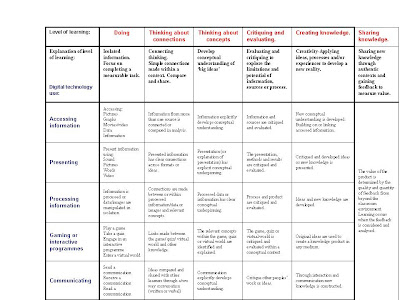 The matrix includes 6 levels of activites given to students:
Doing
Thinking about connections
Thinking about concepts
Critiquing and evaluating.
Creating knowledge.
Sharing knowledge.
A learning activity will commonly be at more than one level.
The matrix explores different ways that digital technologies are used in learning and how each use has different levels. the different uses in the matrix includes:
Accessing information
Presenting
Processing information
Gaming and interactive programmes
Communicating
Accessing information
Presenting
Processing information
Gaming and interactive programmes
Communicating
I am interested in any feedback about the matrix; either email me or add to comments below.
Link to paper to download: acec2008 (apologies I couldn't figure out a way of including the matrix clearly in the blog!)
Starkey, L. (2008). Evaluating Learning in Classroom Activities using Digital Technologies. Paper presented at the ACEC 2008, Canberra.
Link to paper to download: acec2008 (apologies I couldn't figure out a way of including the matrix clearly in the blog!)
Starkey, L. (2008). Evaluating Learning in Classroom Activities using Digital Technologies. Paper presented at the ACEC 2008, Canberra.


